 Tennessee
 Tennessee
The Volunteer State is home sweet home for ORNL. Our local communities are essential to our character, and our draw as an employer and partner makes East Tennessee ever more attractive to both national and global business leaders in science and technology. Proximity of the lab to the University of Tennessee and the Tennessee Valley Authority makes our region fertile ground for scientific discovery and innovation that produces solutions of national and global significance.
Our user facilities and expertise draw collaborators and entrepreneurs from around the world—and often keeps them here. ORNL’s unique support programs like Innovation Crossroads and RevV! are contributing to the explosive growth of the advanced manufacturing and clean energy ecosystem in the region. We work closely with our Department of Energy neighbors, such as the Y-12 National Security Complex, the Oak Ridge Institute for Science and Education, the Office of Science Consolidated Service Center, and the Oak Ridge Office of Environmental Management.
According to a 2020 report from the East Tennessee Economic Council and the Howard H. Baker Jr. Center for Public Policy, DOE’s presence in East Tennessee accounts for more than $7 billion in economic impact.

ORNL’s user facilities offer a diverse set of tools for experiments across a range of fields, including biology, materials and energy sciences, physics, engineering, and chemistry. Learn more about ORNL’s user facilities. Data reflects fiscal year 2020 except for scientific publications, which covers 2016–2020. Partner stories reflect work conducted from 2016 to present.
ORNL’s Industrial Partnerships and Economic Development team designs business growth strategies based on a deep understanding of the unique character and interconnectedness of regional businesses and institutions. Through key collaborations, they support entrepreneurial development programs and the transfer of technologies to industry. The team works closely with the State of Tennessee, its Department of Economic and Community Development, and laboratory partners, including the Tennessee Valley Authority and the University of Tennessee, to attract major investors to the state, in turn, propelling jobs growth, advancing the state’s workforce, and supporting the creation of new businesses—all of which bolster Tennessee’s economy.
ORNL’s technical expertise, world-class facilities, and support programs have contributed to recent investments in Tennessee by automotive industry giant Ford Motor Company; nuclear technology innovator Kairos Power; N95 respirator manufacturer Moldex-Metric; electric vehicle battery manufacturer Microvast; IT and business consulting company CGI; battery cell manufacturer Ultium Cells; and electrical power equipment maker Hyosung Heavy Industries, among others.
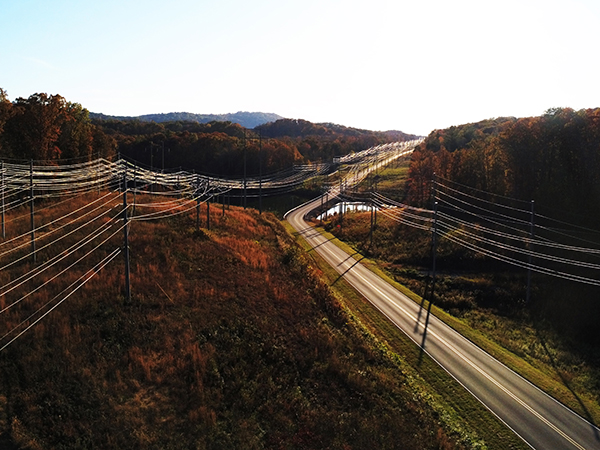
Partnerships between TVA and ORNL date back to the laboratory’s inception. Recent collaborations include the first full-scale computer simulation of a working nuclear reactor and installation of 3D-printed reactor components. Both projects are aimed at accelerating cost-effective deployment of carbon-free nuclear power. Through a new memorandum of understanding, TVA and ORNL are also joining forces to advance decarbonization technologies from discovery to deployment. TVA provides electricity for 153 local power companies serving 10 million people in Tennessee and parts of six surrounding states.
Currently, UT and Battelle Memorial Institute co-manage ORNL for DOE though UT-Battelle. However, UT and ORNL have been closely knit since the laboratory’s early days during the Manhattan Project. Over the decades since, the relationship has flourished through consortia, more than 200 joint faculty appointments, five joint institutes, numerous cooperative research and development agreements, and shared discoveries in genetics, energy science, and other fields. Together, UT and ORNL are helping attract and develop the next generation of scientists and engineers for DOE, continually reinforcing US competitiveness. The newly created UT-Oak Ridge Innovation Institute will support kindergarten through postdoctoral STEM-related education. Over the next 10 years, the institute will create a talent pipeline by recruiting faculty and scientists to the region, attracting and training top-level student talent, and developing new team-based science initiatives focused on solving some of the world’s most pressing challenges.
In addition to its flagship campus in Knoxville, UT has campuses in Chattanooga, Memphis, Martin, and Pulaski. UT also manages the Space Institute at Tullahoma and the Alabama-based Huntsville Research Center; the Institute of Agriculture; and the Institute for Public Service.

ORNL, TVA, and UT worked with Techstars, a worldwide network for entrepreneurs, to evaluate the entrepreneurial ecosystem in the Oak Ridge-Knoxville area. In response to that assessment, Techstars and its local partners have founded the Industries of the Future Accelerator and named its inaugural class. This effort will combine forces of the country’s largest science and energy laboratory, the nation’s biggest public power utility, and research and educational resources that have won international awards for driving technology to the marketplace. The first cohort will refine their technologies, receive mentorship, recruit and develop talent, and connect to potential customer organizations while gaining access to Techstars’ global network.
ORNL employees gave nearly $800,000 to local nonprofits through the laboratory’s employee giving programs in 2021. ORNL’s managing contractor, UT-Battelle, provided an additional $144,000 in corporate contributions.

NellOne Theraputics, an early-stage biopharmaceutical company, licensed a drug delivery system designed to transport therapeutics directly to cells infected by SARS-CoV-2, the virus causing COVID-19. The ORNL-developed technology uses the virus’s spike protein to guide drug-carrying nanoparticles, like liposomes, directly to infected cells.
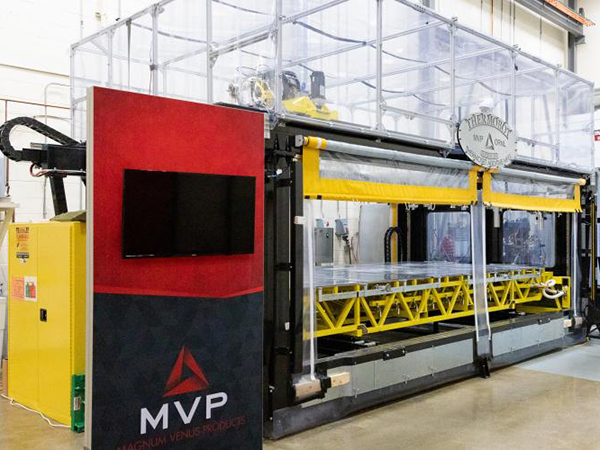
Knoxville-based Magnum Venus Products, a global manufacturer of product solutions for industrial composites and adhesives, and ORNL collaborated in the development of a one-of-a-kind award-winning Reactive Additive Manufacturing system capable of producing large, lightweight parts. RAM enables the production of high-quality products at a faster rate, uses less material, and consumes a fraction of the energy compared to other 3D printers. MVP has signed two licenses with ORNL and offers the large-scale, energy-efficient RAM 3D printer as a product to manufacturers. The printer is anticipated to be used in a wide range of applications for defense, marine, and aerospace industries.

ORNL has expanded its collaboration with Volkswagen and the University of Tennessee to advance electric mobility through breakthrough materials science and recycling concepts. The partnership aims to improve electric vehicle (EV) charging efficiency, starting with the testing of high-power wireless charging technology. Initial trials using ORNL’s advanced electromagnetic coil design have shown up to 98% energy transfer efficiency, helping to accelerate EV adoption. This research is aligned with DOE’s efforts to improve energy efficiency in transportation.

ORNL partnered with the City of Chattanooga to enhance Smart City capabilities through traffic-based energy analyses. A digital twin of the Chattanooga metro area enabled a demonstration that improved situational awareness and control of traffic infrastructure. The demonstration showed up to 17% energy savings by dynamically adjusting traffic signal timing and up to 27% savings by integrating vehicle speed and signal control. This work advances energy efficiency and resilience, supporting DOE goals for optimizing energy use in urban environments. The project also highlights the role of smart cities in advancing energy resilience. Learn more about energy research at ORNL.
Learn more about ORNL’s traffic research in Chattanooga.
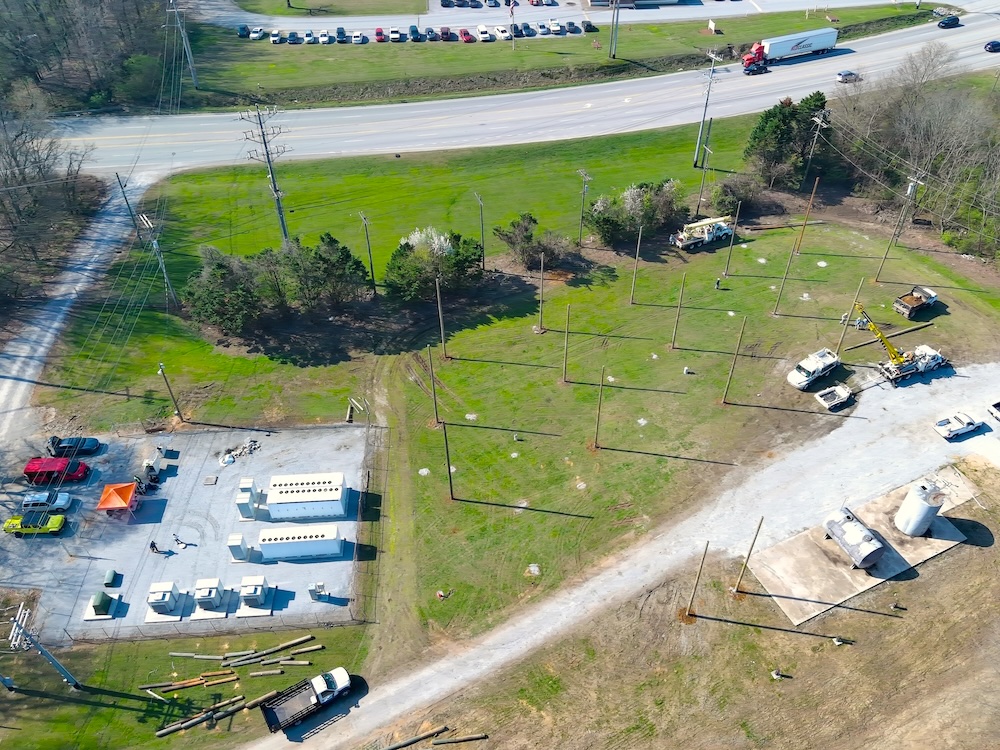
Regional utility EPB of Chattanooga, Tennessee, is partnering with ORNL to deploy a variety of grid technologies. The Collaborative Energy Resilience and Quantum Science joint research effort uses Chattanooga’s highly advanced and integrated energy and communications infrastructure to develop technologies for enhancing the resilience and security of the national power grid while accelerating commercialization of quantum technologies. In a separate project, ORNL is providing real-time simulation of EPB electrical networks that are being converted to microgrids. Boundary expansion algorithms combined with ORNL-developed microgrid controller technology will enable microgrid boundaries to flex to incorporate nearby portions of the EPB grid when those areas would otherwise lose power. ORNL researchers also partnered with EPB to develop and demonstrate an automated drone-based sensor platform for utility line inspections. The platform enables rapid response to damage and malfunctions, ensuring power grid safety and reliability.
For more information, contact [email protected].